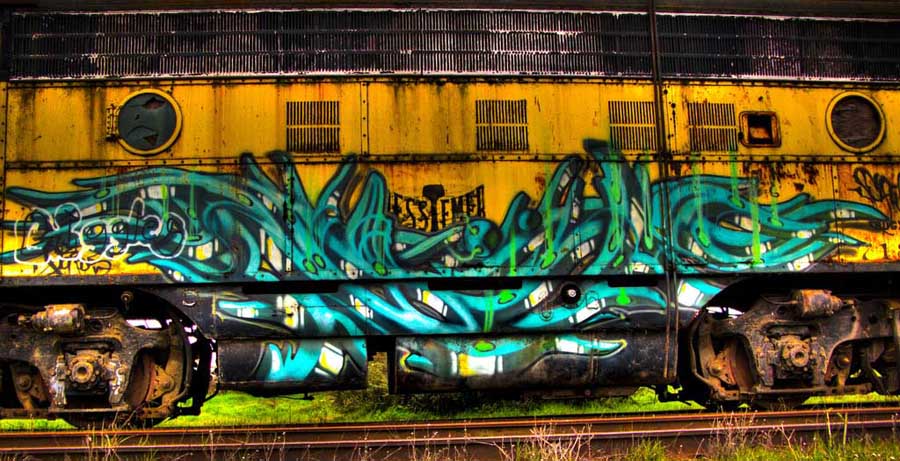
Faunagraphic and Rocket01 Sheffield, England 2008
Anyone who has taken a course in art history knows that romance has had a major influence on some of the greatest works of all time. Whether it was Van Gogh pining over Gauguin so deeply he reportedly severed his ear and sent it to him; or the heated romance between Frida Kahlo and Diego Rivera that arguably led to the pair conquering 20th century Mexican art; art imitates life and one of life’s most endearing staples is love.
 Faunagraphic and Rocket01 collaborative wall mural in Sheffield, England 2008
Incidentally, as movies like Banksy’s "Exit Through The Gift Shop" help provide an ethereal buzz around our generations obsession with replacing crumbling urban domiciles with gorgeous works of art, a new couple has commandeered the ranks of these often cinematic romances.
 Faunagraphic, unnamed mural in Sheffield, England
Rocket01 and Faunagraphic are two incredibly gifted street artists from Britain, who explore some of modern life’s most decayed structures together in a never-ending search for the perfect readymade canvas.
Both of them grew up relatively close to each other in Yorkshire, where gorgeous green expanses of rolling hills and nature were interspersed with the average concrete ruins of an old industrial town.
 Rocket01, "Time for Tea" 2011 mural in Sheffield
Where do they get their inspiration to cover abandoned buildings in gorgeously flowing, naturally delicate paintings? It calls to mind the woman from Sound of Music skipping along through a field of dandelions only to approach a crumbling warehouse’s last standing facade. If Maria Rainer then happened to bust out a few cans of spray paint and transform these cement relics into massive paintings of birds, ecology or beautiful fay women, we might see something close to Faunagraphic’s masterpieces.
 Work from Faunagraphic's recent "Corroded Surfaces" exhibit
Rocket01 tends to add a more urban spread of vibrant, swirling colors. Using accurate portraiture juxtaposed in satirical caricatures, his images become experiments in surrealism. His ability to manipulate light and texture literally transform the walls themselves. It appears as if his pieces grew around these geometric structures much like ivy or vines, naturally evolving in response to their environment.
 One of Rocket01's many character murals in Sheffield 2010
These two styles melt into one all encompassing description of the natural world around us. While Faunagraphic's more soft and beautiful nature scenes serve to provide us with a feeling of zen even in a garbage dump, Rocket01's urban depictions of decadence playfully relate back to us the divine comedy that is human life and society.
 Bonzai, Faunagraphic, Rocket01, Inva in a massive mural collaboration from Stockwell, London 2008
The pair of eco-artists have been featured in several galleries all over England. Their works have also ornamented hoodies, snowboards and a number of other products featured on their websites. While these nontraditional canvases may be the most indicative of their place in the evolving street art revolution, their pieces have also beautified the more historically established white canvases of heavy-duty woven fabric.
Even in these pieces, FaunaGraphic’s amazing talent of recreating landscapes so magnificent they transport their viewer into an organic world of peace and tranquility are only amplified by Rocket01’s ability to create realistic portrayals full of emotion and contrasting color.
 One of Faunagraphic's gorgeous nature canvases from "The Urban View Exhibit" in Bristol.
Whether these artists are working alongside those in their community to transform entire abandoned buildings into unofficial museums or being commissioned to create murals so jaw-dropping, you can barely believe
they’re real; we owe them eternal thanks for adding humanity and passion to our decomposing world of cement and asphalt.
 Rocket01's "Visions" 5ft x 5ft Spray paint on canvas
I’m not sure anyone can sum up this romantic duo better than they themselves can. After all, Faunagraphic’s response to my inquiry on the source of their passion was almost as moving as her artwork. She replied thoughtfully: “A bird doesn't sing because it has an answer,
it sings because it has a song.”


 For the world’s pacifists, environmentalists and lefties,nuclear plants have symbolised domineering power, bellicose potential and radioactive waste. Many of those prone to impending doom were abandoned soonafter the Chernobyl tragedy and others immediately after construction. For many years, power plants have stood tall and forgotten, remnants of a very different industrial age, whilst others still stand proud in their relentless execution.
  Today, however, many of these fossilised and unsightly blocks of cement and their contiguous cooling towers are increasingly hosting interesting, evocative and perhaps even ironic forms of graffiti and entertainment. In Mangaung, South Africa, the Orlando Power Station, a dreary and greying conglomerate of towers was revamped in honour of the 201 FIFA World Cup to celebrate the folkloric art of the region. The community’s heritage are evoked in the graffiti through vuvuzelas, footballers and dancers while tourists and locals alike take to the unusual freefall; for the towers have now been converted into a 100m bungee centre.
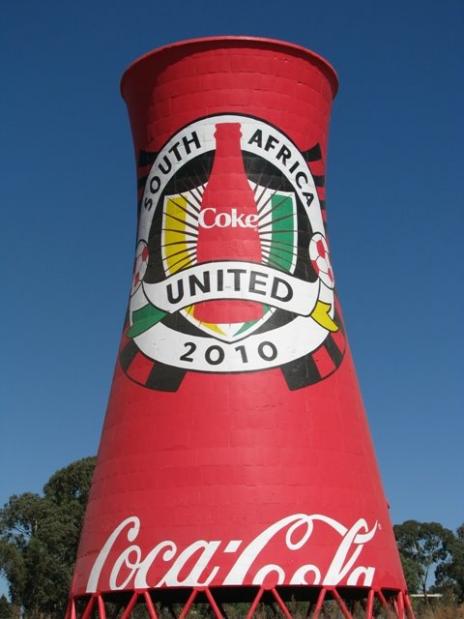
  A subsequent graffitathon-mania has fast spread across South Africa and “Soccer City” in Johannesburg saw the creation of a Coca-Cola ad cum décor. Despite the objections to the choice of subject matter (after all, Coca-Cola’s reputation is disputable), the vacant power plant was converted into a base for the builders, workers and vendors of the World Cup stadium.
  Cooling tower graffiti fever hasn’t hit Africa alone, in Kalkar, Germany, a nuclear project born in the '70s and abandoned ensuing a safety scare was transformed, many years of desertion later, into Kalkar Wunderland, a theme park. The cooling tower is now home to a swing ride and is decorated, somewhat ironically, with mountainous slopes and natural sceneries.
  But nuclear graffiti isn’t a third millennium phenomenon, in fact, the mural for the cooling tower in Cruas that provides France with 5% of its electric energy was thought up in 1991 by artist Jean-Marie Pierret, and was completed by 9 mountaineers, 8,000 hours of work and 4,000 litres of paint! The idea was to focus on the topic of ‘ecology’ and portray the relationship between ‘water’ and ‘air’; in 2005 it was inaugurated with the name ‘Acquarius’.
  Perhaps these decorations are just a form of beautification of what is, essentially, an industrial eyesore. Alternatively, their refurbishment is a hopeful attempt to integrate the concept of positive nuclear energy. Whatever the deal, it provides for some unusual eye-catching photos and will perhaps drive away the nuclear demon.


 Faunagraphic and Rocket01 Sheffield, England 2008
 Faunagraphic and Rocket01 collaborative wall mural in Sheffield, England 2008
 Faunagraphic, unnamed mural in Sheffield, England
 Rocket01, "Time for Tea" 2011 mural in Sheffield
 Work from Faunagraphic's recent "Corroded Surfaces" exhibit
 One of Rocket01's many character murals in Sheffield 2010
 Bonzai, Faunagraphic, Rocket01, Inva in a massive mural collaboration from Stockwell, London 2008
 One of Faunagraphic's gorgeous nature canvases from "The Urban View Exhibit" in Bristol.
 Rocket01's "Visions" 5ft x 5ft Spray paint on canvas




 Austin has a reputation as being a haven for artists. Known as the "Live Music Capital of the World", Austin attracts musicians, artists and creative people from all walks of life.
 One of the long-time Austin hangouts is the infamous "Hole in the Wall", located on the Drag by the University of Texas campus. The wall art here changes periodically, with some pieces being semi-permanent and others lasting weeks or maybe months. Here is an homage to Bob Dylan painted on the outside wall of "Hole in the Wall."
 Austin is home to some amazing graffiti artists. Although still technically illegal, that doesn't stop some of Austins most hardcore underground artists from getting up. Some private business owners welcome artists to get up on their walls. Home Slice Pizza is currently famous for having a sick wall showcasing some of Austin's finest. Here is a taste of some of the art you can encounter with your pizza at Home Slice.
 A drive around Austin will allow you to encounter some truly beautiful pieces by some amazing artists.
  Thanks to all these artists for keeping the streets of Austin pretty and bright. Keep it real.

 Posts
Posts